Section 1: Physical Quantities & SI Units
Syllabus Code: K323 | SEC 2027 Exams
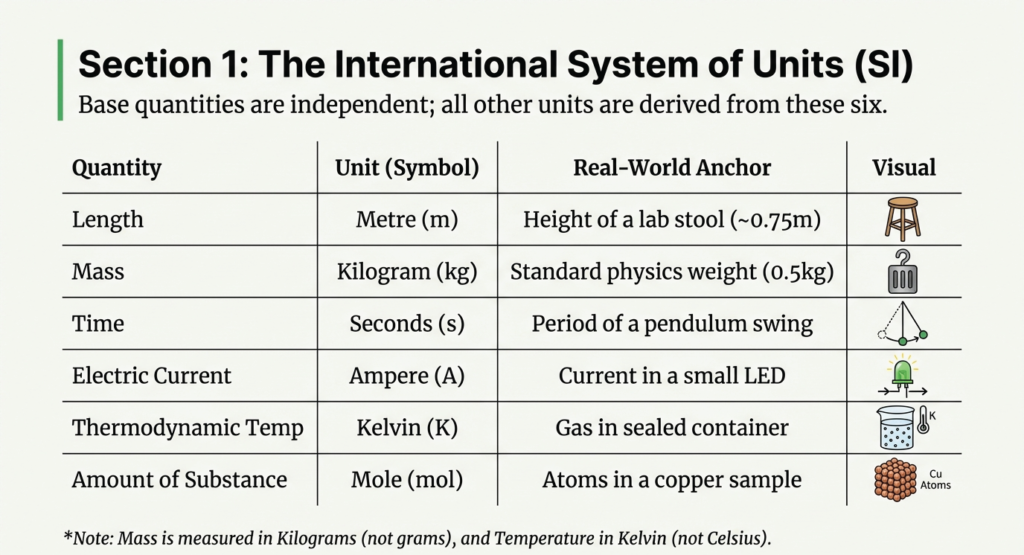
Q1: Which of the following is an SI base unit?
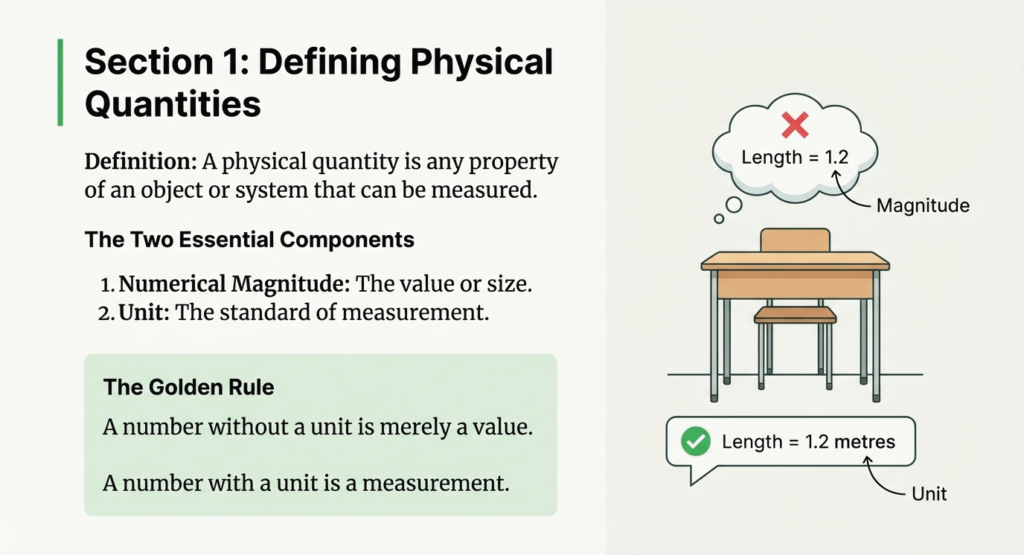
Q2: A number without a unit (e.g., “1.2”) is scientifically known as:
Q3: Which symbol correctly represents the SI base unit of length?
Q4: How many base quantities are independent in the K323 syllabus?
Q5: What is the SI base unit for electric current?
Q6: Which is the SI base unit for mass?
Q7: Thermodynamic temperature is measured in:
Q8: The SI unit for ‘Amount of Substance’ is:
Q9: A real-world anchor for 0.5 kg is:
Q10: The ‘Golden Rule’ states that a number with a unit is a:
Q11: Which symbol correctly represents the SI unit for time?
Q12: In the measurement “Length = 0.75 m”, 0.75 is the:
Q13: Which is the symbol for the base unit of Electric Current?
Q14: Mass is measured in kilograms. Is this a base quantity?
Q15: The unit Kelvin (K) is used for:
Q16: Which of these is a derived unit (not a base unit)?
Q17: The real-world anchor “Current in a small LED” refers to:
Q18: Which prefix is officially part of a base SI unit?
Q19: If a desk is 120 cm wide, what is this in SI base units?
Q20: Base units are “independent”. This means:
Section 1: Open-Ended Inquiry
OEQ 1: A student records the mass of a standard physics weight as “0.5”. Explain why this is incomplete[cite: 8, 11, 12, 13].
OEQ 2: In the SI system, what are the base units for Thermodynamic Temperature and Amount of Substance?